Monday, April 26, 2010

Dan Graham


"Curves for E.S." 2005


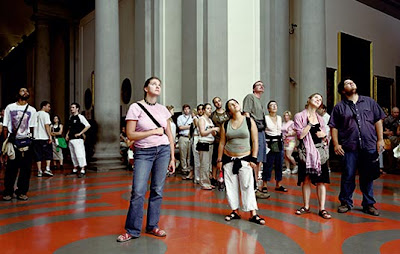
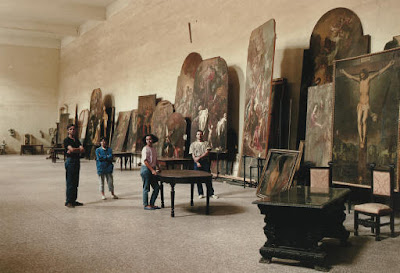
Thomas Struth

"Audience 6 (Galleria Dell'Accademia), Florenz" 2004

"The Restorers at San Lorenzo Maggiore, Naples" 1989

Jenny Holzer

"Projections" 2007 at Mass Moca

Art & Its Institutions

The Museum is an institution to preserve and protect the history of art as well as provoke a scene of the art in "the contemporary", as Heartney describes "a center for cultural provocation". I find it as a protector, a safe place where expensive things are kept. I want to know how museums find a balance between displaying the old and new? How do they rotate?

How will the growth of galleries and biennials effect the traditional museum?

I think that artists today are trying to break the conventions of "normal museum routine" by pushing performance art as well as abandoning the museum itself and creating work that can not be captured and displayed within its walls.

How has globalism changed the economic standards of a museum? of the Western, Eurocentric institutions?

How much of an established institution is part of a "great artist's" life?
Do we need to be established by institutions to be recognized?

Andreas Gursky


"Toys 'R' Us" 1999


''Pyongyang I'', 2007


"Dubai World III" 2008

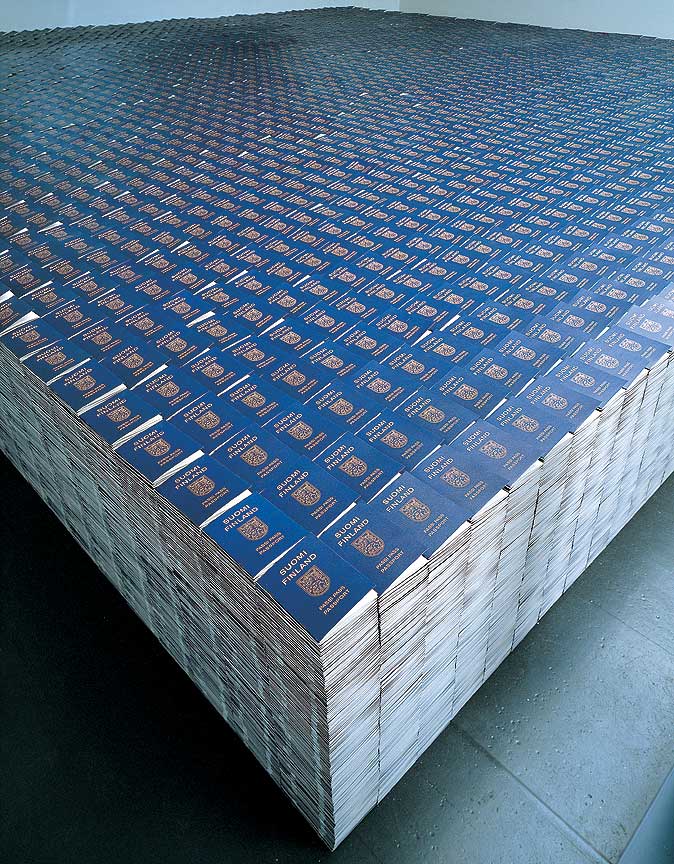
Alfredo Jaar


"One Million Finnish Passports" 1995

Alighiero E Boetti


"Untitled" - Victorian Boogie Woogie 1972

5042 envelopes, 35,280 stamps


Friday, April 23, 2010

Art and Globalism

Here are some questions to think about before our discussion on Monday....

What is the difference between globalism and globalization?

What are pros and cons of globalism, who are its benefactors?

How how does this shape the identity of the western art world?

How does globalism affect the inclusion of women artists?

Is globalism a freeing up of art venues or an invitation to more competition between the others and established art institutions?

How does globalism affect your point of entry into the art world?

Is globalism a new means for pushing western ideals?

What traits make up a global artist?

Wednesday, April 21, 2010

Exhibition Review: Criteria

  • What is the natural audience response of the exhibition's viewers? Immediate response? Overall response?
  • What was the curator trying to say about the layout and settings of the exhibition in comparison to its content? Does anything stand out? What is the most prominent medium? 
  • What is the underlying message? Common trends? 
  • How does the work correlate to one another? How do they relate to current topics, events, social, political, environmental status?
  • If there are multiple trends or messages, do they contrast? mislead? or work together?
  • Does the exhibition flow?
  • Which works stand out? Which works fall flat? This includes describing in detail how the work comes across to the viewer. 
  • How does this exhibition work into the art world of today? How does it relate to the past or present?

Carl Pope: The Mind of Cleveland


The Mind of Cleveland Website: artist Carl Pope's mission to raise awareness of publics thoughts through graphic art and design.

Art and the Quotidian Object: Response Images

Gabriel Orozco "Extension of Reflection" 1992


Variations of Marcel Duchamp's "Bottle Rack".......

Bethan Huws "Tour (Weiss)" 2007

Huang Yong Ping, "100 Arms of Guan-Yin" 1997

Andre Raffray, "Shadow of the Bottle Rack" 1993

Haim Steinbach, "OneStar Assisted" 2007

Art and the Quotidian Object Response

I'm thinking about art and its question of limits like I think about the limits of our world. The idea of what art can and can not be is like thinking about the dimensions of our universe. The unknown vastness is comparable to the possibilities of art, it is just up to artists to push the boundaries. Is there an end of the road?

When is an art object not quotidian? When it is not considered art? When the quotation marks are removed?

Is Gabriel Orozco trying to capture the action of an object or trying to make it stuck in time? The photograph really changes a piece. Does an action become an object when it is photographed?

"It is the focus of an opaque, if suggestive, sensory experience. And it is this opacity that stimulates the free play of imagination and understanding." Margaret Iverson
How would an opaque sensory experience be different from a transparent sensory experience?

Iverson goes onto explain how each object suggests an opposite subject that is different from its appearance through reaction and inversion of our perception. Is she considering that nothing is what it seems? Does every object suggest something different and not obvious?


Monday, April 19, 2010

Art and Identity Response

I find it interesting when artists step out of the social barriers of the artworld (galleries and museums) and into the reality of what artists are trying to express. When art is staged or simply is an experience of our social reality, it is more honest and less safe. It is much more of a reality.

David Hammons "Bliz-aard Ball Sale" 1984 performance in Cooper Square, New York City

What are the external forces that shape our identity?
Social oppression?
Consumerism?
Government control?
Corporate Control?
Home life psychology?
Social classes?
Economics?

How much of our identity is controlled by an inner essence and how much of it is controlled by the outside sources?

John Locke states that we all begin as a blank canvas and everything that we experience is everything that develops us.

How much is nature and how much is nurture in regards to identity?
Mary Kelly "Postpardum Document" 1973-79


Art and Identity Response

What I took as Linda Nochlins' answer to "Why have there been no great women artists?" is the idea of Nature vs. Nurture. It is not a born, genius essence that will automatically surge an artist into greatness, rather the advantageous, social environment that one is subject to or subjects themselves to. Yes the genius nugget probably should be there too for greatness to be recognized. It was not in the social cards, however, for women or minorities to prosper in the arts even if they had the talent up until the twenty first century. The recognition is not something that emerges out of nowhere. Stars need to line up in order for greatness to be recognized, or the social order and allowance for this to happen needed to change.

I think there is a strong sense of realism in the work of social minorities, which I'm more drawn to than the humorous mockery art. Cultures are defining the truths of today in our present day social atmosphere of the "outsiders".

Heartney writes "such works reveal the way in which racism, poverty and social and personal dysfunction combine to define and limit the lives outside the 'mainstream culture'."

Does this statement also define our mainstream culture as functional? I think there is a strong essence of dysfunction in the identity of mainstream culture that globally we are only now becoming conscious of.

Pepon Osorio "Badge of Honor" detail 1995

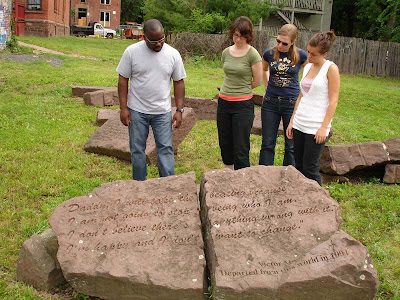
Carl Pope "Silent Wishes, Unconscious Prayers and Dreams...Fullfilled" 1996

Carl Pope interviewed family and friends of several Hartford young people who had died early, often a result of violence. These Portland brownstone slabs are etched with the words of the deceased as remembered by those close to them. Pope's feelings that the young people in some way anticipated their early deaths is reflected in the quotes on the stones. The project was installed in 1996 and is still up at 128 Albany Avenue in the Clay Hill neighborhood.Carl Pope interviewed family and friends of several Hartford young people who had died early, often a result of violence. These Portland brownstone slabs are etched with the words of the deceased as remembered by those close to them. Pope's feelings that the young people in some way anticipated their early deaths is reflected in the quotes on the stones. The project was installed in 1996 and is still up at 128 Albany Avenue in the Clay Hill neighborhood.

text from: http://www.realartways.org/archive/carlPope/silentWishes/Pope.htm


Sunday, April 18, 2010


Wim Delvoye "Cement Truck scalemodel" 2004

Roxy Paine "Maelstrom" 2009
The Iris and B. Gerald Cantor Roof Garden
The Metropolitan Museum of Art, New York, NY

Monday, April 12, 2010

Art & Nature & Technology Comments

I disagree with the idea that the human body is just a prosthetic of the brain. If we were plastic silicon robots hooked up to our brains then yes our bodies would be functioning prosthetics. But we are not. Our bodies are constructed of thousands of other processes and are alive - sometimes not regulated by the brain, but other chemical or physical processes. I'm not a doctor or scientist but I know from living that we are not prosthetics.

I also feel that this transhuman research should not be conducted at all or on individuals with brains that function well enough already. There are many people in this world and even in our country and our state suffering whose needs could be met with the amount of time, money and energy spent conducting this research.

Art & Abstraction Comments

I found Donald Judd's notation about how painting would always "retain a semblance of illusion". Does this mean that his sculpture would always retain a semblance of object? It doesn't. Just as painting is not always a semblance of illusion. Where does that line disappear when is art disconnected from the schemas that give it a type?

I also found interesting the idea of drawing leaving the viewer with the experience of making that mark. Abstraction, by placing the viewer into the position of the artist. This may not even need to be through abstraction, but it is an area of art that I think is interesting and often looked over. Letting the viewer recognize how exactly that mark was made, or exactly how it felt. Leaving the evidence of the process behind.

This idea is seen in Willem de Kooning's "Untitled IV" from 1984...


I question the work of Robert Ryman. He strips down everything in painting to just a painting itself. A blank canvas with imageless brushstrokes, wood and fastners. I guess there is a sense of purity that he is describing, but where can he go from there? Is that the beginning of painting or the end?


Robert Ryman "Philidelphia Prototype" 2002


Terry Winters "Morula III" 1983 Lithograph

Tuesday, March 30, 2010

Sunday, March 7, 2010

Radicant Response 3.

1. Bourriaud pg. 148-149:

"On numerous occasions-notably on the subject of the performance The Silence of Marcel Duchamp is Overestimated (1964) - the German artist makes fun of the bourgeois side of Duchamp, which according to Beuys was made manifest by the fact Duchamp dared to put an individual signature on a urinal (Fountain, 1917), that is, on an object collectively produced by real workers in real kaolin mines. Beuys implies that the signature expropriates the labor of these workers, thus reproducing the mechanism of capitalism, the social division between wage earners and owners of the means of production. Duchamp a small-time boss?"

When first reading this section, I completely agreed with Beuys. Duchamp really attached himself to the urinal when he put his name directly on the ceramic piece. But then I began to think further; didn't Duchamp sign "Fountain" with the signature, 'R.Mutt"? In a prior Art History course I was told this significance and I believe that the particular signature, R.Mutt has something to do with the manufacturer of the actual urinal. That is something that I have to look further into.

However, I think that when Duchamp "pedestalized" (my new word) an object that was not his own, an object of reality rather than art, signed and dated it, he was merely signing the idea of the readymade object. The idea of it, rather than the craft and construction of the ceramic urinal - but I can definately see Joseph Beuys' logic as well.

2. Cultural Rain

When Bourriaud began to describe the mass of cultural production, information and networking that is constantly flowing through our lives as a "cultural rain", I really began to consider the connections to this analogy. These words began to arise as well as their connections to this idea...

- Flood
- Mist
- Stream
- Hurricane
- Erosion
- Washout
- Downpour
- Drizzle
- Condensation
- Hail
- Storm
- Surge
- Fog
- Tide

I thought about how each of these words relates to the "precipitation" of information and its variable effects on our world - much like that of water.

3. Some artists, including myself, wonder when they are going to break the next boundary in the art world. Many think to ourselves "When I am going to be up there on those museum walls?" When will my moment arise. Bourriaud speaks of Michel Foucault's interpretation of an epoch break through on page 157...

"Moreover, we have as much chance of rediscovering the configuration of a past epoch, Michel Foucault used to say, as of seeing the same hand dealt four times in a row in a game of poker."

Whether this quote speaks of reliving a profound moment in history, or making a new and different break through; I think that he is right. Nothing will ever happen exactly if you are trying too hard. It is in the mistakes, risks, experiments and margins that these moments of greatness will happen.

In our last seminar class, we began to discuss the question "What do we do now, how do we get to that point?" A few answered, "work - hard work and lots of it". Others answered, "honest work- work that comes from within". I think that the lecture from Carolee Schneeman also helped artists to understand that sometimes we don't know what we're doing and that's okay. I read this quote to myself often, reminding myself to let things happen...

"I think of the things about being an artist is that you should be allowed to test murky, unclear, unsure territory or all you have left are substitutes that signify these positions. Having it all together is the least interesting thing in art, in being alive." - Judy Pfaff

So instead of putting our efforts into being great, well-known, ground breaking and so on, we should put our efforts into our honest work.

4. I'm probably not the only one who is overwhelmed when they are under the "cultural rain cloud" of not only the art world but the global, internet information world. My question to Bourriaud would be...

How do you navigate through the mass amount of art and cultural production that is streaming, raining and storming through the world without getting swept away? Is there a point when the input surpasses the capacity?

5. I love Bourriaud's reference to maps and navigation. It is another analogy that I also compare contemporary artists too. Voyagers in a a sea of discovery, creating maps for others to follow.